Celebrating 51 years of Voyageurs National Park
![Scenic island in Voyageurs National Park. [o] Jakob Widmark](/sites/default/files/styles/internal_page_banner/public/images/blog/Island%20in%20Voyageurs%20%E2%80%93%20Credit%20Jakob%20Widmark.jpg?itok=cA_Jx6GN)
Today, Voyageurs National Park is celebrating its 51st anniversary. Located along the Minnesota-Canadian border, the state's only national park was established in 1975. However, the vision for a park began much earlier. In 1891, people expressed concerns about the region's growing development and potential impacts to the surrounding lakes and forests. As a result, they advocated for creating a national park in the northernmost part of the state. However, it was another 80 years before Congress designated the area as a national park.
Although Voyageurs National Park is named after French Canadian fur traders, Indigenous people have lived, hunted, and fished in this region for thousands of years.
Visitors can see evidence of Indigenous culture, early homesteaders, and fur traders throughout the park. The area is considered the traditional homeland of the Boise Forte Band of Chippewa, along with 17 other federally recognized affiliated nations, seven Canadian First Nations, and the Northwestern Ontario Métis Community, closely associated with the lands and waters of the park, who still hold deep connections to the land.
The park, together with the Voyageurs Conservancy, works collaboratively to educate visitors and share information about the region’s cultural significance and history while protecting access to sacred and culturally important sites.
![Multiple sites in the park are water access only. [o] Voyageurs Conservancy](/sites/default/files/styles/image_gallery/public/image-gallery/voyageurs%20national%20park%20photo%20credit%20voyageurs%20conservancy.jpg?itok=aTHXFplb)
![Walleye are one of the species that draw anglers to the park. [o] Riley Benson](/sites/default/files/styles/image_gallery/public/image-gallery/waleye%20photo%20credit%20Riley%20Benson.jpg?itok=QoLlnVGL)
![A common loon is one of the most sought after species for photographers. [o] Mark Oram](/sites/default/files/styles/image_gallery/public/image-gallery/loon%20photo%20credit%20Mark%20Oram.jpg?itok=RJLdW2SR)
Explore the park’s water trails
The park’s landscape is beautiful, with nearly 40% of it covered by water. Voyageurs is on the southern edges of the Canadian Shield, which can often be seen along shorelines. The shield is a large region of exposed, ancient bedrock that makes up the oldest and most stable part of North America. Though these rocks are commonly seen throughout Voyageurs and the Boundary Waters, it’s what makes the region so scenic and iconic. Four large lakes make up most of the national park: Rainy Lake (Gojiji-zaaga'igan), Kabetogama Lake (Gaa-biitoogamaag-zaaga'igan), Namakan Lake, and Sand Point Lake. They are all part of the Rainy River watershed, which has headwaters in the Boundary Waters and flows north into Hudson Bay.
Surrounding all the water are thick forests. The most common types of trees are pine, spruce, fir, aspen, and birch. As the season changes, so does the beauty and scenery of the landscape. Wildlife is abundant in the park, and if visitors are quiet (and lucky), they may spot a moose, wolf, black bear, or lynx. But smaller mammals are more likely to be spotted, such as beaver, mink, grouse, and river otters. Waterfowl are abundant throughout the spring and summer, and many species come to nest and raise their young.
Voyageurs Wolf Project Video | One camera, one year: the wild moments at a remote trail crossing
Developed by researchers at the University of Minnesota, the Voyageurs Wolf Project is an ongoing effort to study wolves in and around Voyageurs National Park. Seeking to better understand wolf behavior in the summer, researchers began tracking wolves using GPS radio collars and trail cameras. Their work has since documented predation and foraging behavior, as well as reproduction and pup survival. In addition, their work has provided insight into the behaviors of other species in the ecosystem. (video used with permission)
Where the water meets the sky
With all that water, people come to Voyageurs to fish, swim, boat, and camp. Anglers ply deep waters for walleye, lake trout, pike, and bass. There are over 150 campsites throughout the park, and most are water-access only, with some mainland sites available inside and outside of the park. Because motorized boats are allowed, it’s not uncommon to see fishing boats and houseboats cruising around all summer long. This allows many people to easily access the park. However, like its neighbor, the Boundary Waters, it’s important to be able to navigate your way throughout the myriad of islands and bays.
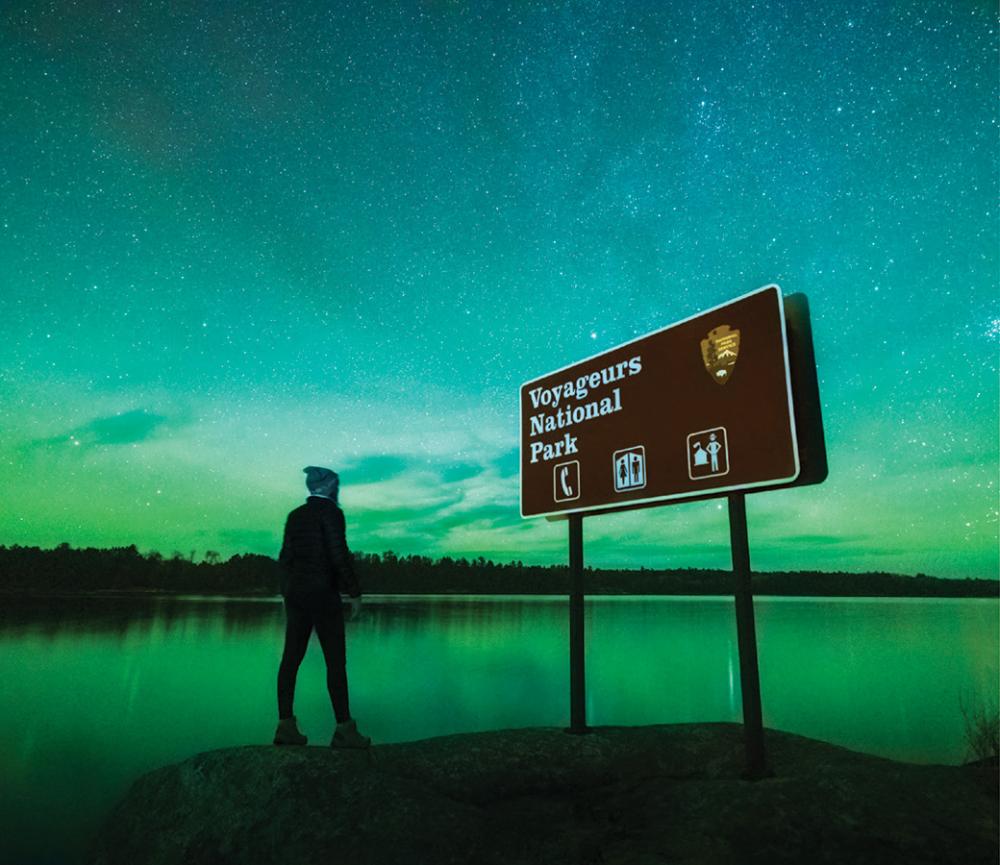
And did we mention the dark skies? Voyageurs was designated an International Dark Sky Park in 2020. With minimal light pollution, visitors can enjoy a canopy of stars, constellations, planets, and even the northern lights.
When you go, be sure to stop at one of the four visitor centers where you can learn more about the park’s history, geology, and dark skies.
National park in the path of pollution
Voyageurs National Park and the Boundary Waters Canoe Area Wilderness share the same watershed, the Rainy River - Headwaters watershed. Voyageurs and the Boundary Waters are under threat from mining pollution. The national park lies downstream from a proposed sulfide-ore copper mine that would be built near the shore of Birch Lake, just a few miles outside the Boundary Waters.
Because the watershed flows north, pollution from the mine could travel directly into Voyageurs and eventually reach the larger watershed that drains into Hudson Bay. This would create irreversible harm to these lakes and river systems.
Join the community of wilderness protectors today! Help us preserve these watersheds forever.
![Houseboat moored in Voyageurs. [o] Chris Herman](/sites/default/files/styles/image_gallery/public/image-gallery/Houseboat%20Moored%20%E2%80%93%20Credit%20Chris%20Herman.jpg?itok=C22HQChp)