What Governor Walz's Executive Order means for the future of the Boundary Waters
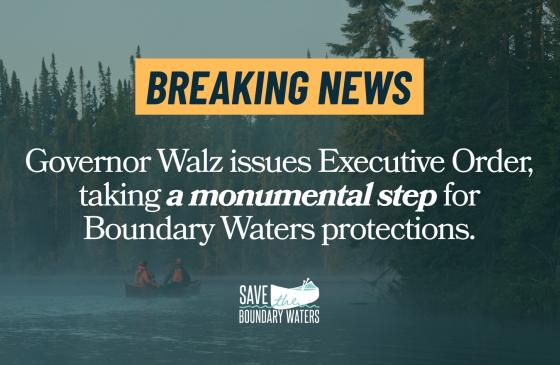
Governor Walz issues Executive Order, taking a monumental step for Boundary Waters protections
After months of watching Washington strip away federal protections for the Boundary Waters, Minnesota just answered back. A new Executive Order (EO 26-10), signed August 18 by Governor Tim Walz, shuts the door on sulfide-ore copper mining in the watershed that feeds the Wilderness using every tool the state has right now, while the fight for permanent protection continues.
Join us in thanking the Governor for stepping up for the Boundary Waters!
What the state just did
The Governor’s directive covers six specific actions, all focused on the Rainy River Headwaters, which is the watershed of the Boundary Waters:
- Freezes state environmental review and permitting by the Minnesota Department of Natural Resources and the Minnesota Pollution Agency for any new sulfide-ore copper mining proposals in the watershed, until a pending legal challenge to the state's own outdated mining rules is fully resolved and subsequent rulemaking more protective of the Boundary Waters is completed.
- Cuts off state cooperation with any federal environmental review of any sulfide-ore mine proposals in the watershed. The state will not help advance sulfide-ore copper mining in the Boundary Waters watershed.
- Stops new state mineral leases in the watershed, closing the door on new projects getting a foothold.
- Stops new state surface leases for sulfide-ore copper mining activities, including for disposal or storage of tailings or other waste materials, in the watershed.
- Puts every existing state lease in the watershed under the microscope, directing agencies to strictly scrutinize state sulfide-ore copper mining leases in the watershed and to enforce compliance with lease terms to the fullest extent the law allows.
- Directs the Minnesota Department of Natural Resources to draft legislation that would permanently ban sulfide-ore copper mining in the watershed, for the Minnesota Legislature to take up in 2027.
Put simply, under this Executive Order, sulfide-ore copper mining does not get a start in the Boundary Waters watershed, existing leaseholders are on notice, and the Legislature will be asked to make protection from sulfide-ore copper mining permanent.
Why now: a direct answer to Washington
The Governor responded to what the federal government did earlier this year and in 2025. It is worth understanding exactly what that was, because it's what makes Minnesota's action a rebuke and a recognition that this special place is deeply threatened and needs the state’s protection now.
In 2023, the federal government withdrew 225,504 acres of federal land and minerals in the watershed from the federal mineral leasing program for 20 years in what’s called a Mineral Withdrawal. The federal government followed a fair and comprehensive process that ran 454 days, included eight public listening sessions, drew nearly 675,000 public comments in favor of a 20-year ban, and rested on 22 separate scientific resource reports. The U.S. Forest Service's own analysis found that a sulfide-ore copper mine in the watershed could cause extreme and irreparable harm.
This spring, Congress threw that entire record out. Using a fast-track procedural tool called the Congressional Review Act (CRA), a law meant to provide scrutiny to agency actions deemed to be rules. Despite Mineral Withdrawals never having been deemed to be rules subject to scrutiny under the CRA, the Senate voted 50-49 and the House 214-208 to overturn the mining ban. No new public listening sessions. No new science. The Forest Service's own extreme harm finding wasn't revisited, just discarded. Legal experts called this use of the CRA “extraordinarily legally questionable.”
And the process left out the people with the deepest legal claim. The Bois Forte, Grand Portage, and Fond du Lac Bands, whose treaty rights to these lands and waters predate the State of Minnesota itself, were not consulted. As U.S. Senator Martin Heinrich put it during the debate, the maneuver didn't just reverse a policy, it cut tribal nations out of the conversation entirely.
At the same time, the Trump administration moved to reduce and weaken future environmental reviews to as little as 14 days for an environmental assessment with no public comment and 28 days for a full environmental impact statement, with only a 10-day public comment window. This would be a fraction of the review that led to the 2023 decision to ban sulfide-ore copper mining in the Boundary Waters watershed.
The Governor’s order is drawing an important contrast . Where the federal process this year sidelined science, shut out tribal nations, and gave the public no voice, the State is using the authority it still holds, over its own leases, its own permitting, its own cooperation, to draft legislation and to hold the line that has been abandoned by the federal government.
What this doesn't do
The fight isn't over.
This is a Governor’s Executive Order, not a law. It can be undone by a future state administration the same way it was created - with a signature, not a legislative vote. It is also tied to the outcome of ongoing litigation over the state's own mining rules and new rulemaking. And the enforcement action on existing state mineral leases directs review-and-enforce authority, not an automatic cancellation, meaning it gives the Department of Natural Resources a directive to act on rights and violations.
The piece built to last is the final one - the direction for legislation. A state law banning sulfide-ore copper mining in the watershed of the Boundary Waters would be far harder to undo than an executive directive, but it's not law yet; that’s why it’s important for Minnesotans to contact their state legislators to make permanent protection for the Boundary Waters a reality
The bottom line
Governor Walz just used every lever his administration has, right now, to stop new sulfide-ore copper mining from getting a foothold in the Boundary Waters watershed, and did it in direct response to a federal process that bypassed science, cut out tribal nations, and gutted public input.
This is an important bridge, but not a destination. The Boundary Waters watershed's lasting protection by the State of Minnesota still depends on the outcome of the state's court case and rulemaking and, most of all, on whether the Legislature turns this directive into permanent law. The work now is making sure it does, and you can help.
Contact your Minnesota Representative and Senator today and tell them: it’s time to make permanent protection for the Boundary Waters a reality.